
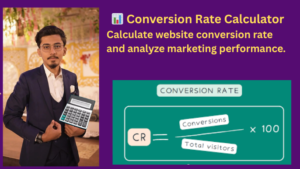
Conversion Rate Calculator
Analyze your website performance instantly
Conversion Rate Calculator: How to Measure and Boost Your Marketing Success
In the world of digital marketing, traffic is a vanity metric; conversions are the reality. Whether you are running an e-commerce store, a personal blog, or a SaaS platform, knowing how many of your visitors actually take action is the key to growth.
Our Conversion Rate Calculator is designed to help you strip away the guesswork and understand exactly how hard your traffic is working for you.
What is a Conversion Rate?
A conversion rate is the percentage of visitors to your website who complete a desired goal (a conversion) out of the total number of visitors. A “conversion” can be anything from a product purchase and a newsletter sign-up to a simple click on a “Contact Us” button.
The Conversion Rate Formula
While our tool does the heavy lifting for you, the mathematical formula used is:
For example, if mrkwebtool.com receives 10,000 visitors and 200 of them sign up for a service, your conversion rate is 2%.
(Insert the Calculator Tool Code Here)
Why Should You Track Your Conversion Rate?
Tracking this metric is vital for several reasons:
-
ROI Analysis: It tells you if your paid ads (Google Ads, Facebook Ads) are actually making money or just wasting your budget.
-
Identify Bottlenecks: A high traffic volume but a 0.5% conversion rate usually signals a problem with your website’s design, trust factors, or checkout process.
-
Compare Channels: You can use this calculator to see if your Organic Search (SEO) traffic converts better than your Social Media traffic.
What is a “Good” Conversion Rate?
“Good” is relative to your industry, but here are some general benchmarks for 2026:
-
E-commerce: 1.5% – 3%
-
B2B / Lead Generation: 3% – 7%
-
SaaS: 2% – 5%
-
Finance/Insurance: 5% – 10%
If your rate is below 1%, it’s time to look into Conversion Rate Optimization (CRO).
5 Proven Ways to Increase Your Conversion Rate
If our calculator showed a result lower than you’d like, don’t panic. Use these strategies to improve your performance:
-
Improve Page Load Speed: Even a 1-second delay in mobile load times can drop conversions by 20%.
-
Simplify Your CTA: Make your “Buy Now” or “Sign Up” buttons stand out with high-contrast colors and clear text.
-
Use Social Proof: Adding customer testimonials or “As Seen On” badges builds the trust necessary for a visitor to convert.
-
A/B Testing: Experiment with different headlines and images to see which version resonates more with your audience.
-
Mobile Optimization: Ensure your forms and buttons are easy to click on a smartphone screen.
Final Thoughts
Measuring your performance is the first step toward improving it. Use the Conversion Rate Calculator on mrkwebtool.com regularly to monitor your marketing campaigns and ensure every visitor has the best possible chance of becoming a customer.
🚀 Master Your Metrics: How to Use This Calculator
Optimizing your digital strategy starts with data. Follow these six simple steps to analyze your performance and turn your traffic into a growth engine.
1. Input Your Traffic Volume
Begin by entering the total number of Unique Visitors or sessions your website, landing page, or specific ad campaign received. This represents your total “audience reach” for your selected timeframe.
2. Define Your Success (Total Conversions)
Input the number of visitors who completed a specific goal. Whether it’s a completed sale, a newsletter signup, or a PDF download, this number represents your successful actions.
3. Include Campaign Revenue
For a deeper financial analysis, enter the Total Revenue generated by these conversions. This allows the tool to calculate your revenue per visitor, helping you determine how much each “click” is actually worth to your business.
4. Generate Your Results
Once your data is entered, click the “Calculate Now” button. Our tool uses the latest 2026 marketing algorithms to instantly process your conversion percentage and performance metrics.
5. Evaluate Performance Insights
Review the results area to see your Conversion Rate and efficiency data. Our tool doesn’t just give you a number; it provides context to help you understand if your current performance is “Healthy” or needs immediate attention.
6. Refine and Optimize
Use these insights to pivot your strategy. If your conversion rate is low, focus on Conversion Rate Optimization (CRO)—such as improving page speed or simplifying your checkout process—to maximize the value of every visitor to mrkwebtool.com.
Conversion Rate Calculator: Master Your Website’s Efficiency
In the competitive landscape of digital marketing, generating traffic is only half the battle. The true measure of success lies in conversion—the art of turning a casual visitor into a loyal customer, subscriber, or lead.
Our Conversion Rate Calculator is a professional-grade utility designed to help website owners and marketers move beyond “vanity metrics” and focus on what actually drives revenue.
What Exactly is a Conversion Rate?
A conversion rate is the percentage of users who complete a specific, desired goal on your website. Whether you are tracking a product purchase, a newsletter signup, or a contact form submission, this metric tells you how persuasive your website truly is.
The Math Behind the Metric
Calculating your performance is straightforward. The formula used by our tool is:
(Total Conversions ÷ Total Visitors) x 100 = Conversion Rate (%)
Example: If your latest campaign at https://www.google.com/search?q=mrkwebtool.com brings in 5,000 visitors and 200 of them make a purchase, your conversion rate is a healthy 4%.
Why This Metric is the “North Star” of Marketing
High traffic volumes are meaningless if your visitors leave without taking action. Monitoring your conversion rate is essential because:
-
Maximizes ROI: It allows you to earn more from the traffic you already have, reducing the need for expensive new ad spend.
-
Identifies Friction: A low rate often highlights technical issues, such as slow loading speeds or a confusing checkout process.
-
Scales Growth: Once you know a page converts well, you can confidently increase your marketing budget knowing the investment will return a profit.
Connecting the Dots: The Marketing Ecosystem
Conversion rates don’t exist in a vacuum. To get a full picture of your digital health, you should analyze this data alongside other key performance indicators (KPIs):
| Metric | How it Connects | Recommended Tool |
| CPC | Measures the cost of every click entering your funnel. | CPC Calculator |
| CTR | Tracks how many people were interested enough to click your ad. | CTR Calculator |
| CPM | Helps you balance the cost of impressions against the resulting actions. | CPM Calculator |
| ROAS | Determines if your conversions are generating enough profit. | ROAS Calculator |
Strategies to Skyrocket Your Conversion Rate
If our calculator shows your performance is below industry standards, consider these Conversion Rate Optimization (CRO) techniques:
-
Optimize Page Speed: A fast-loading page prevents “bounce” and keeps users engaged.
-
Clear Call-to-Action (CTA): Ensure your “Buy Now” or “Sign Up” buttons are bold, visible, and use persuasive language.
-
A/B Testing: Test two versions of a headline or image to see which one resonates better with your audience.
-
Mobile-First Design: Ensure your mobile users have a seamless experience, as most web traffic now happens on smartphones.
Who Benefits from This Tool?
-
E-commerce Owners: To track sales efficiency and product page performance.
-
SEO Specialists: To ensure that organic rankings are translating into business value.
-
Ad Agencies: To provide transparent reporting to clients on campaign success.
-
SaaS Founders: To measure sign-up rates for free trials or demos.
❓ Frequently Asked Questions (FAQs)
What is a “good” conversion rate?
While it varies by industry, an average website conversion rate sits between 2% and 5%. Top-tier performers often see rates of 10% or higher.
Does a high bounce rate affect my conversion rate?
Yes. If users leave your site immediately (bounce), they never get the chance to convert, which lowers your overall percentage.
How often should I check my conversion metrics?
For active campaigns, you should monitor your rates weekly. For general website health, a monthly audit is recommended to catch any sudden drops in performance.